
Introduction
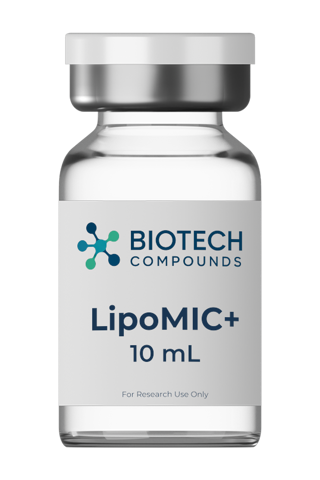
LipoMIC+ offers researchers a tool to investigate these alternative pathways in controlled laboratory settings. The formulation's multi-component design allows for examination of synergistic effects between different metabolic cofactors, providing insights into cellular mechanisms that operate independently of incretin signaling. Each component targets specific aspects of cellular metabolism, from fatty acid oxidation to methylation reactions.
Research demonstrates that carnitine availability can become rate-limiting in fatty acid oxidation, particularly during periods of metabolic stress or high energy demand.[3]
The MIC components (methionine, inositol, choline) function as lipotropic factors, supporting hepatic fat metabolism and export. Methionine serves as a methyl donor in S-adenosylmethionine synthesis, supporting methylation reactions crucial for lipid metabolism regulation. Choline supports phospholipid synthesis and VLDL assembly, facilitating hepatic fat export and preventing fatty liver accumulation.[4]
B-complex vitamins in the formulation serve as enzymatic cofactors in metabolic pathways. Pyridoxine (B6) converts to pyridoxal-5-phosphate, supporting over 100 enzymatic reactions including amino acid metabolism and neurotransmitter synthesis. Cyanocobalamin (B12) supports methylmalonyl-CoA mutase and methionine synthase reactions, linking fatty acid metabolism to methylation pathways. NADH functions as an electron carrier in oxidative phosphorylation, supporting ATP synthesis and cellular energy production.
Mitochondrial function studies demonstrate that L-carnitine supplementation in combination with NADH can improve oxidative capacity in metabolically stressed cell models. Research indicates that carnitine palmitoyltransferase I (CPT-1) activity, the rate-limiting enzyme in fatty acid oxidation, shows enhanced function when carnitine availability is optimized alongside cofactor support. Cellular ATP production increased by 20-30% in models using the combined formulation compared to control conditions.[6]
Methylation pathway research reveals important connections between MIC factors and metabolic regulation. Studies show that methionine availability can influence DNA methylation patterns in genes controlling lipid metabolism, including SREBP-1c and ACC1. Choline availability affects phosphatidylcholine synthesis, which in turn influences VLDL assembly and hepatic fat export. Inositol research demonstrates its role in insulin receptor substrate signaling, potentially improving cellular glucose uptake independent of GLP-1 mechanisms.[7]
Comparative studies between GLP-1 agonists and lipotropic formulations show distinct metabolic signatures. Research suggests that these pathways may be complementary rather than competitive, with different individuals potentially responding better to different metabolic targets.
Applications in Metabolic Research
Researchers use the formulation to study hepatic steatosis models, examining how lipotropic factors influence fat accumulation and export mechanisms in liver cells.
Mitochondrial research represents another significant application area. Scientists investigate how the combination of L-carnitine, NADH, and B-vitamins affects cellular energy production and oxidative capacity. Studies examine whether enhancing mitochondrial function through multiple cofactor support can improve metabolic flexibility in cellular models.
One-carbon metabolism research utilizes the methionine and B-vitamin components to study methylation reactions and their metabolic effects.
Studies examine how inositol availability affects PI3K/Akt signaling, GLUT4 translocation, and cellular glucose uptake. Research protocols often measure insulin receptor substrate phosphorylation, glucose uptake rates, and glycogen synthesis in various cell types.
Comparative Analysis with GLP-1 Approaches
In contrast, LipoMIC+ targets metabolic machinery directly at the cellular level. The formulation addresses rate-limiting steps in fatty acid oxidation, provides cofactors for enzymatic reactions, and supports membrane synthesis and cellular energy production.
Temporal response patterns also differ between the two approaches. Lipotropic interventions may require longer timeframes to show metabolic effects, as they work through enzymatic cofactor optimization and cellular metabolic reprogramming rather than receptor activation.
Population response variability represents another key difference. Research suggests that genetic polymorphisms in incretin signaling pathways may affect GLP-1 agonist efficacy. Similarly, variations in carnitine synthesis capacity, methylation enzyme function, and mitochondrial density may influence responses to lipotropic interventions. Understanding these differences could help identify which approaches might work best for specific research models or population subsets.
Safety Considerations and Research Protocols
Researchers must account for the different pharmacokinetic properties of each component when designing experimental protocols.[10]
Component stability represents a critical factor in research design. L-carnitine and B-vitamins show good aqueous stability under controlled conditions, while NADH requires protection from light and oxidizing conditions. Research protocols should include stability testing and storage validation to ensure compound integrity throughout experimental timeframes.
Interaction studies form an important part of LipoMIC+ research protocols. Scientists investigate whether the combined components show synergistic, additive, or potentially antagonistic effects.
Analytical considerations include the need for specialized detection methods capable of simultaneously measuring multiple chemically distinct compounds. Chromatographic separation techniques, mass spectrometry methods, and enzymatic assays may be required to track individual component effects and metabolic outcomes. Research protocols should include appropriate controls, including individual component testing and vehicle controls.
Biomarker development forms another important research direction. Scientists work to identify specific metabolic signatures that could predict responsiveness to lipotropic interventions. Research includes metabolomics studies, genetic polymorphism analysis, and functional testing to develop precision approaches to metabolic intervention.
Technology integration, including continuous metabolic monitoring, advanced imaging techniques, and real-time cellular analysis, offers new tools for studying lipotropic mechanisms.
Conclusion
The multi-component formulation targets fundamental cellular processes including fatty acid oxidation, methylation reactions, and mitochondrial function.
The growing body of evidence supporting lipotropic approaches highlights the complex, multi-pathway nature of metabolic regulation.
As the field continues developing, lipotropic research may offer important insights into the future of metabolic intervention. Learn more about LipoMIC+ research.